

Stop Losing Money on Cold Room Downtime
In the Middle East, a failed compressor in a commercial cold storage or food processing facility isn’t just an inconvenience—it’s a financial emergency. When legacy Copeland hermetic reciprocating models break down under 50°C summer temperatures, contractors need an exact specification replacement. You cannot afford to waste days modifying piping or reconfiguring electrical panels while your inventory spoils.
The BOM Code Trap: Threaded Spud vs. Brazed Tube
Many buyers make the costly mistake of only matching the model number and cooling capacity (e.g., CR47KQM). However, the 3-digit BOM (Bill of Materials) code at the end of your nameplate is what actually dictates the physical connections of the unit.
According to Emerson’s official dimensional data, CR series compressors are manufactured with two completely different connection types:
Threaded Spud Adaptors: Utilizing Rotalock connections (e.g., 1 1/4-12 UNF-2A for suction and 1-14 UNS-2A for discharge).
Brazed Copper Tubes: Utilizing stub tubes requiring direct brazing (e.g., 19.1mm / 0.75″ I.D. for suction).
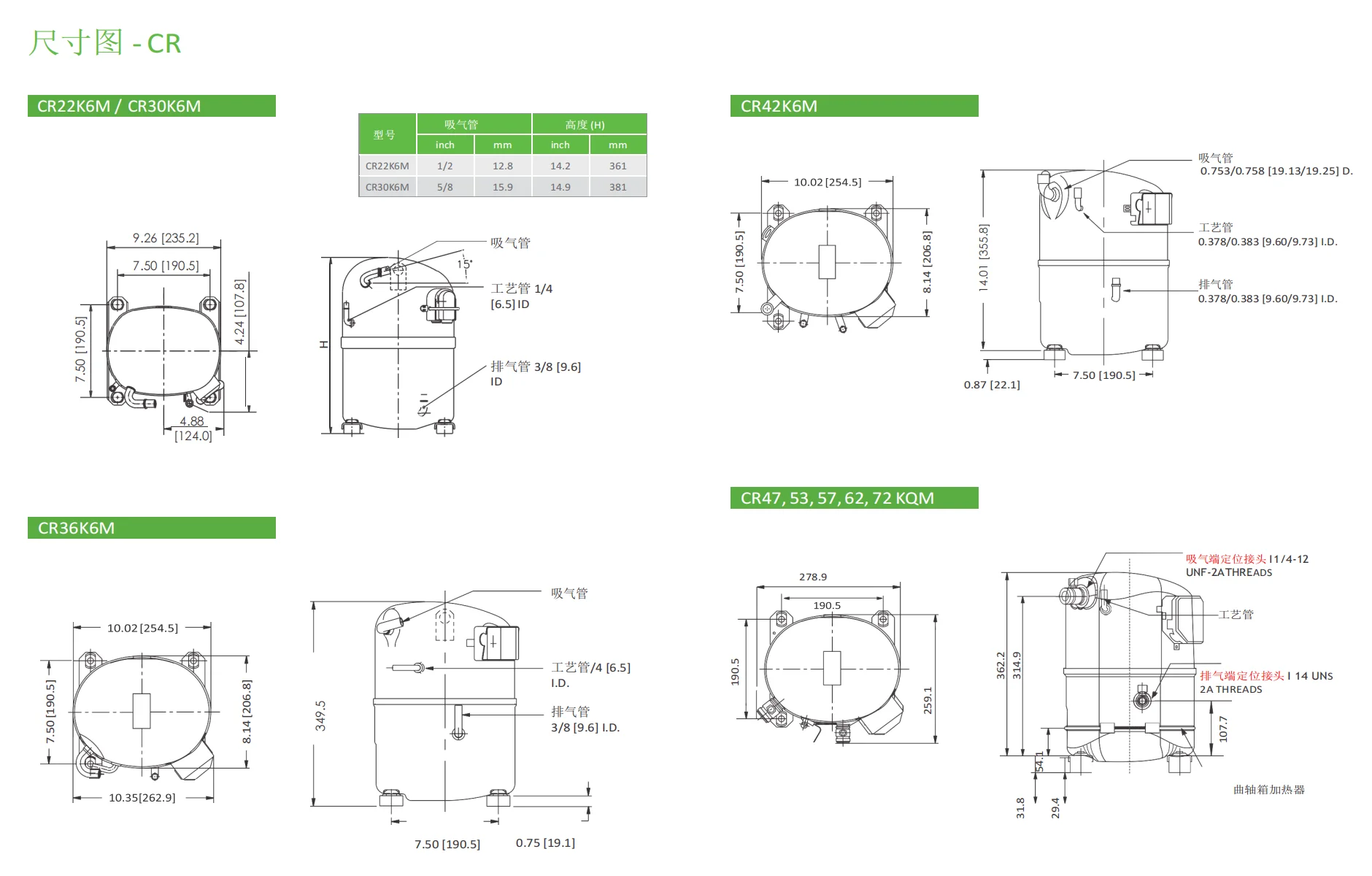
BOM codes dictate physical connections: Threaded Spud vs. Brazed Tube.
If you ignore the BOM code and buy a stub-tube model when your existing system uses threaded rotalock valves, your field technicians will be forced to cut, expand, and weld copper pipes on-site. This causes severe project delays, increased labor costs, and a much higher risk of system leaks.
Voltage Compliance for Saudi Arabia’s 60Hz Grid
Electrical mismatches are another major cause of rapid compressor burnout. For Saudi Arabia’s strict 380V/60Hz industrial grid, you must verify the motor electrical code:
TFD is Your Standard: The TFD code covers 3-Phase 380-420V at 50Hz, but officially it is also rated for 3-Phase 380/460V at 60Hz. This makes TFD a highly compatible and safe match for the Saudi 60Hz power supply.
Avoid PFV Mismatches: Do not accidentally order the PFV code. This is designed for 1-Phase 208/230V (60Hz) light-duty applications. Hooking up a 1-Phase compressor to a 3-Phase industrial system will result in severe operational issues or immediate burnout.
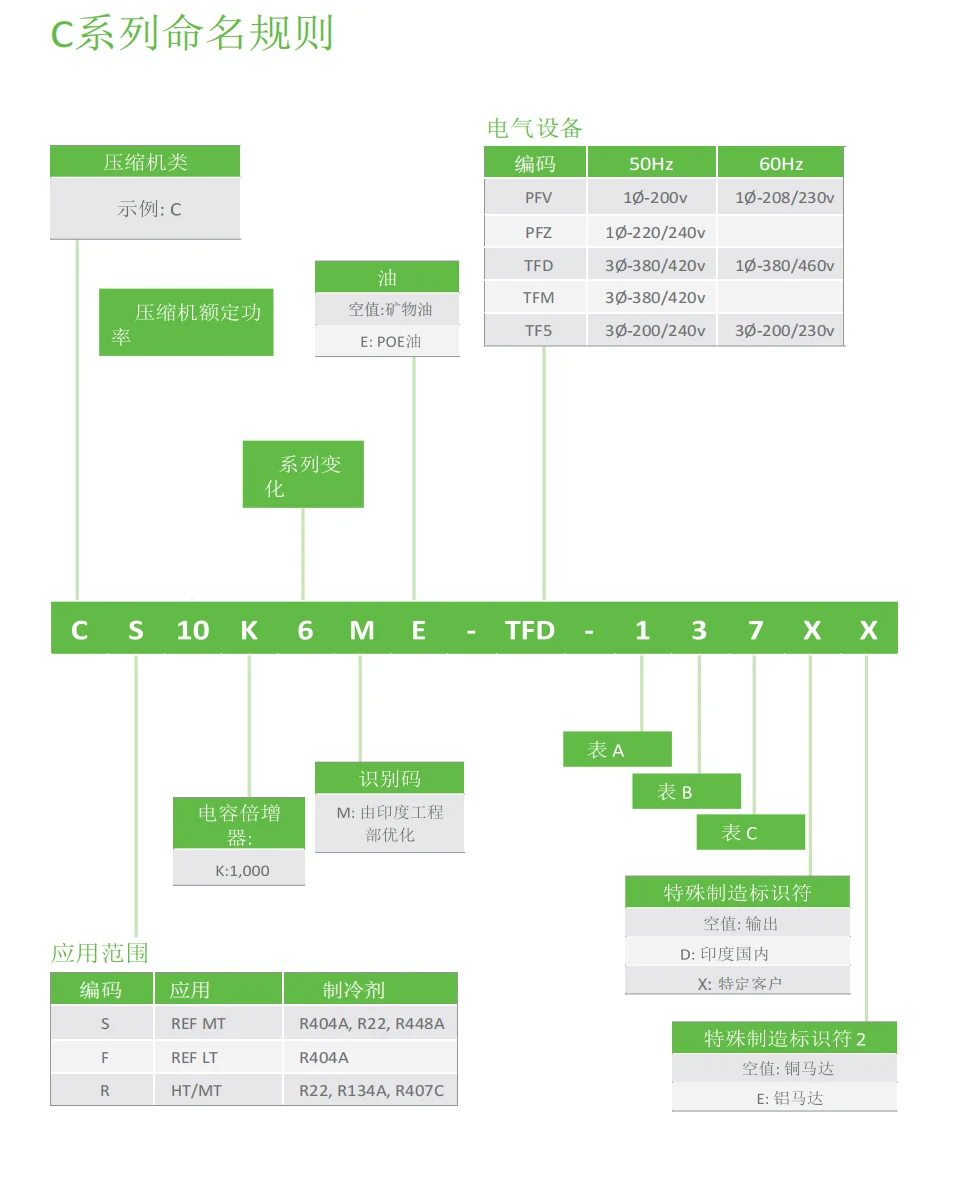
Copeland CR compressor voltage code reference. Always verify TFD (380/460V) for Saudi Arabia’s 60Hz grid, and avoid PFV (1-Phase) on three-phase systems.
Beyond Specs: Surviving Middle East Operating Conditions
Getting the BOM and voltage right is only half the battle. Across Saudi Arabia and the wider Gulf region, extreme heat, unstable grids, and sandstorms will quickly kill a newly installed compressor if your field technicians cut corners.
1. Extreme High-Ambient (T3) Challenges
CR series compressors are workhorses for medium and high-temperature refrigeration. However, in 50°C+ ambient conditions, discharge temperatures skyrocket. Ensure your condenser is properly oversized, and meticulously verify that the system maintains correct subcooling and superheat to prevent oil breakdown.
2. Refrigerant & Oil Compatibility
If you’re replacing a legacy R22 unit and upgrading to R404A or R407C, you can’t just swap the gas. You need POE oil. Look closely at the compressor nomenclature: a blank space indicates mineral oil, while an “E” (e.g., CR47KQE) stands for POE oil. If you mix R22 mineral oil residual with R404A POE oil, the system will create sludge and clog the expansion valve, causing catastrophic failure.
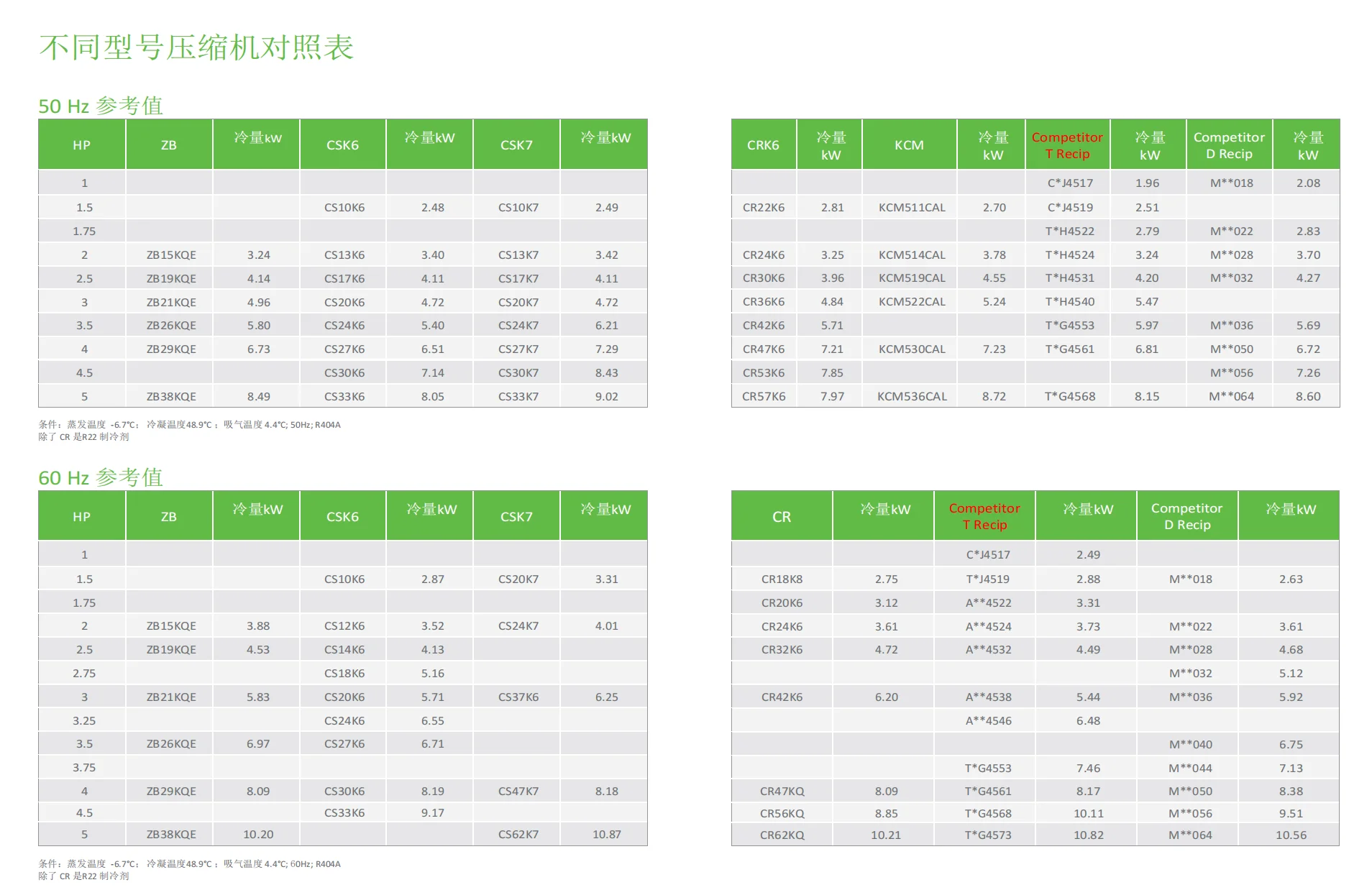
Compressor cross-reference table: 50Hz vs 60Hz cooling capacity (kW). Always match the operating frequency to your grid and verify the cooling capacity before selecting a replacement.
3. Grid Fluctuations & Phase Protection
Saudi Arabia’s power grid can experience severe voltage fluctuations. For single-phase CR models, verify your wiring matches the correct PSC, CSIR, or CSCR configuration. For three-phase models, installing a phase sequence and phase failure protector is absolute non-negotiable to avoid immediate motor burnout.
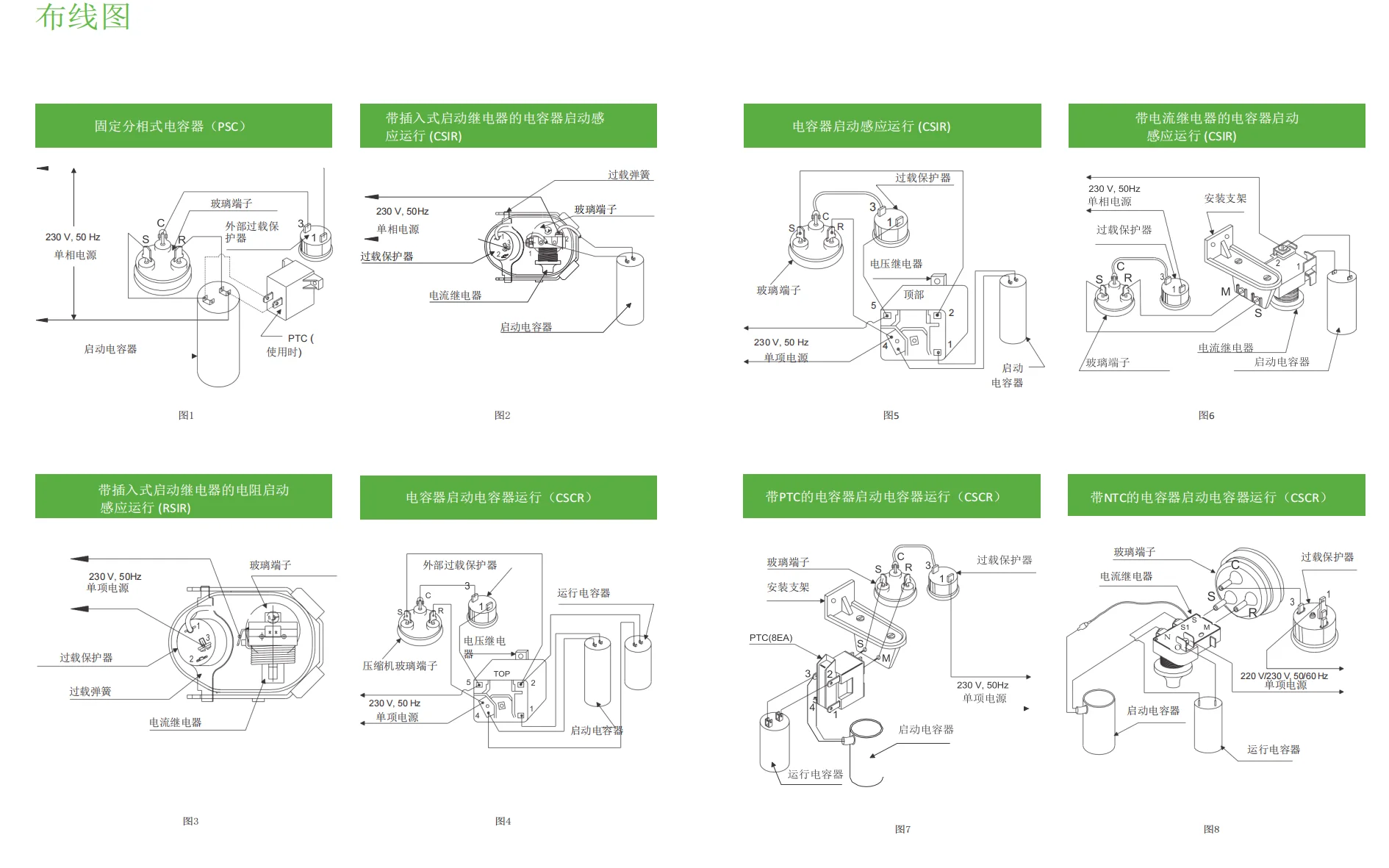
Correct wiring configuration (PSC, CSIR, RSIR, CSCR) is only the first step. Always verify voltage across C & R terminals, proper earthing, and secure electrical joints before startup.
4. The Non-Negotiable Installation SOP
A proper installation prevents repeat failures. Do not let your technicians skip these steps:
Nitrogen Purge: Always purge low-pressure nitrogen through the tubes while brazing to prevent internal oxidation and contamination.
Deep Evacuation: Pull a vacuum from both the high and low sides to achieve a strict 200-micron level.
Crankcase Heater: Pre-heat the oil for at least 12 hours before initial startup to prevent liquid slugging.
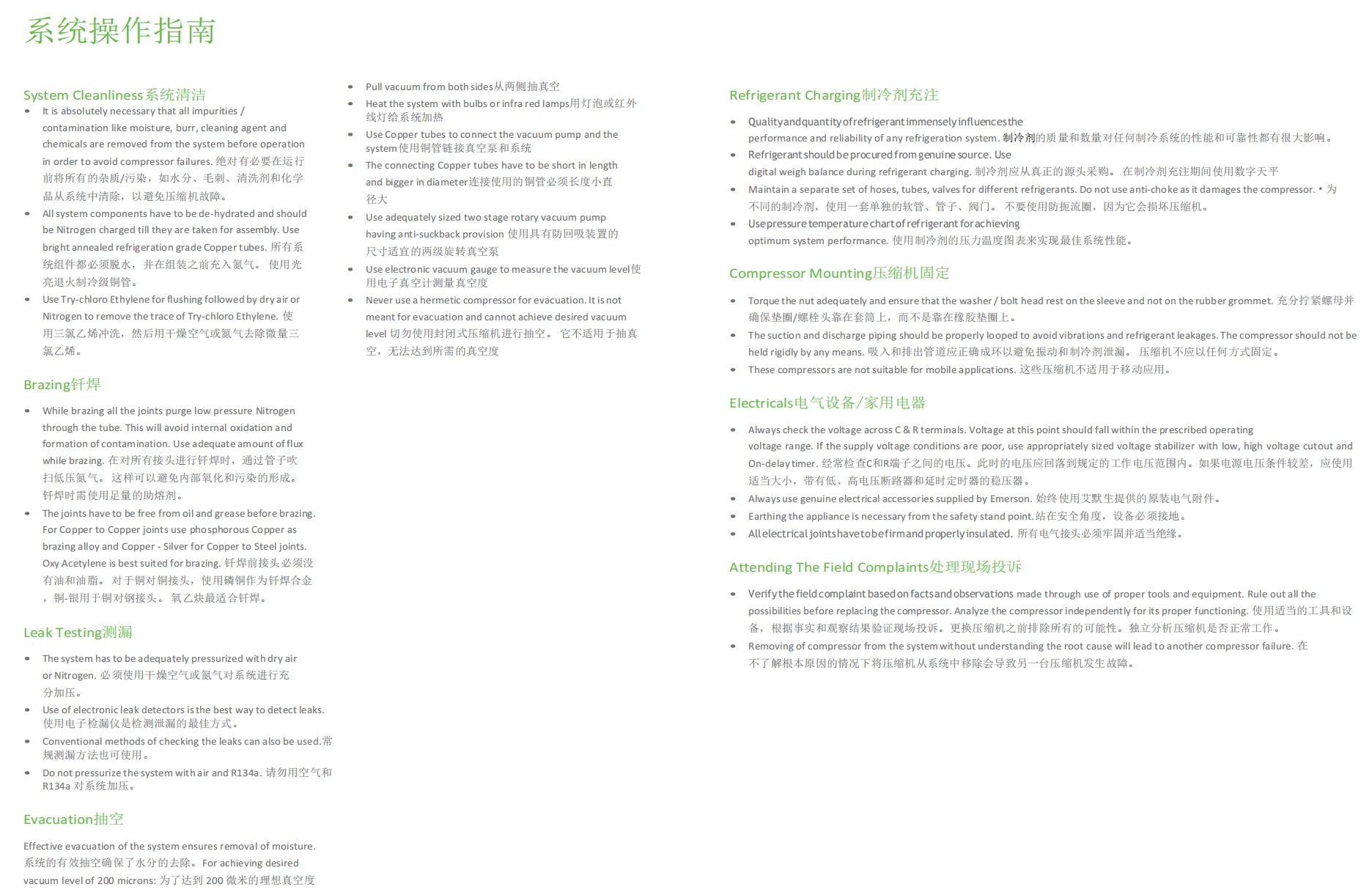
Follow the non-negotiable installation SOP: nitrogen purge while brazing, deep vacuum to 200 microns, and crankcase heater pre-heating.
Get Your Exact Specification Replacement from Our Shanghai Factory
Skip the trading company markups and avoid specification guesswork. Our engineering team specializes in decoding legacy Copeland CR models like the CR47KQM-TFD, CR32K6E-PFV, and CR62KQM-TFD. We maintain a vast inventory of top-tier reciprocating compressors ready for direct EXW export to the Middle East.
[ 📸 Upload Your Nameplate Photo for BOM Decoding & Fast Quote ]

WeChat
Scan the QR Code with wechat